
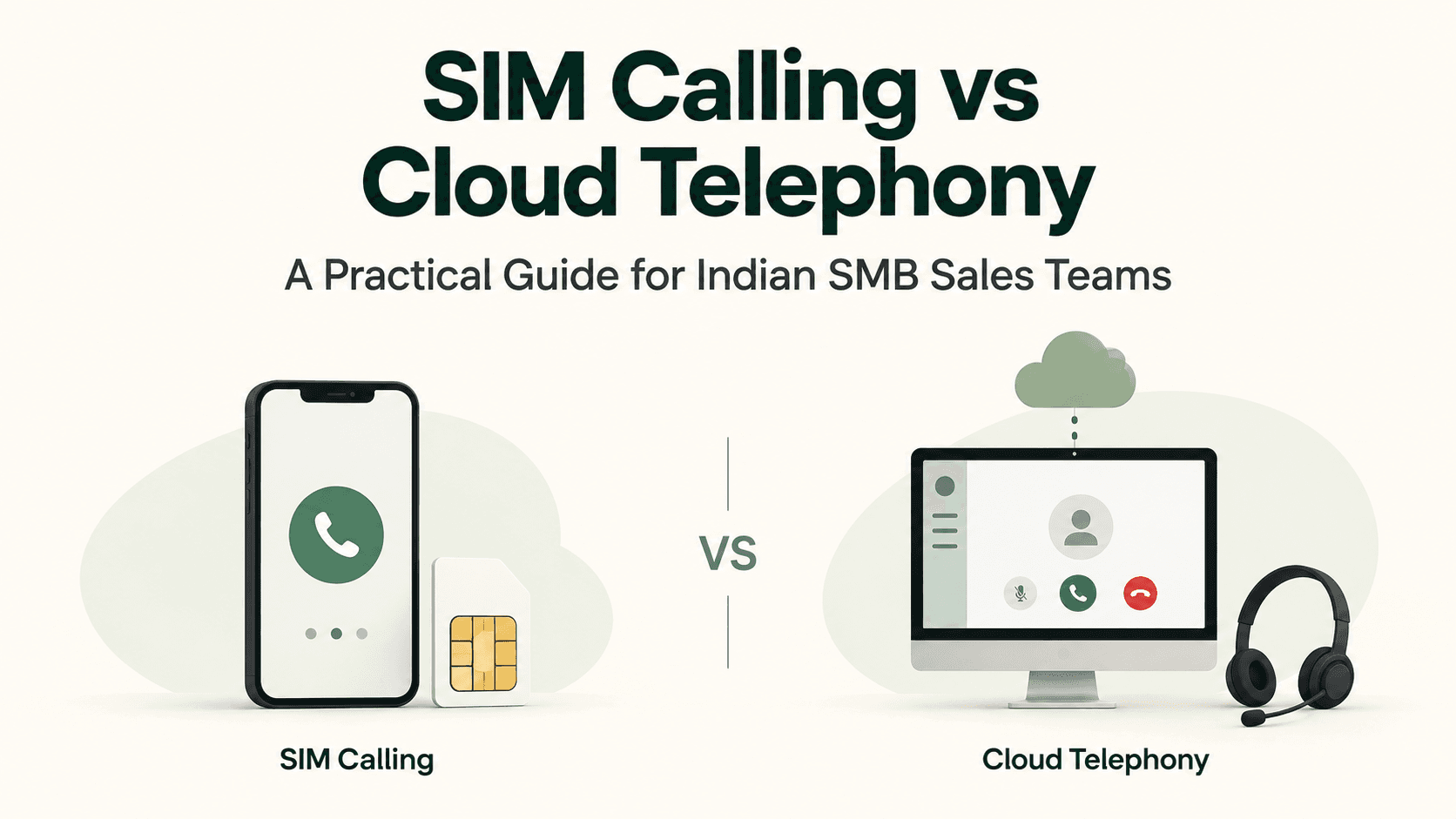
Choosing the right communication backbone for your sales team can significantly impact response times, lead conversion, and overall efficiency. For many Indian small and medium businesses, the decision comes down to two common approaches: SIM calling through the mobile app and cloud telephony. Each has strengths depending on your team size, geography, and how you manage follow-ups. This guide walks you through practical considerations, using Triostack CRM features like a shared WhatsApp inbox, AI call transcription, lead scoring, and automated assignments to illustrate real-world outcomes.
In the examples below, you’ll see how teams balance on-device calling with cloud-based control and analytics. The goal is to pick a setup that keeps your reps engaged, speeds up follow-ups, and provides clear visibility into which conversations move deals forward.
What is SIM Calling in Triostack CRM?
How SIM calling works in Triostack
SIM calling through the Triostack mobile app uses your device’s SIM to place and receive calls. The advantage for many field and inside sales reps is simplicity: no extra hardware, and calls are made from a familiar mobile experience. When paired with Triostack CRM, calls can be logged against the right lead or contact, and you can access call recordings on compatible Android devices. If you keep notes during or after a call, those details can feed into lead scoring and follow-up suggestions to help you decide whom to contact next.
Practical scenario: a local distributor
Imagine Riya runs a regional beverage distribution business. Her team uses SIM calling from the Triostack mobile app to reach chain retailers in a 100 km radius. Each call is logged, and if there’s no immediate follow-up after the call, the system suggests a follow-up task the next day. Riya’s team also uses the shared WhatsApp inbox to answer product questions while leaving notes about the conversation in Triostack. When a lead shows interest during a call, the AI transcription captures Hinglish notes, and the platform assigns the lead to the most suitable sales rep based on location and workload.
Benefits and limits for inside sales
- Low setup friction: use existing mobile devices for calling, with call logs and recordings captured as part of the CRM profile.
- Simple handover: experienced reps can take over a conversation by sharing context in the CRM notes and in the WhatsApp inbox.
- Limited centralized control: if you need advanced routing or multi-user queues, you may still rely on a cloud-based approach to scale beyond a single device.
- Data visibility: AI transcription in Hindi, Hinglish and English helps you understand customer needs even when conversations happen in regional languages.
What is Cloud Telephony?
How cloud telephony differs from SIM calling
Cloud telephony provides a centralized, internet-based calling framework that can route calls, manage multi-user queues, and deliver centralized dashboards. In a sales context, this can mean shared numbers, call routing to teams, and a single place to view call history, recordings, and outcomes. When used with Triostack CRM, cloud telephony integrates with features such as a shared WhatsApp inbox, templates, flows and automation triggers, along with AI-driven tools like lead intent analysis and automatic lead assignment. While SIM calling depends on the individual device, cloud telephony emphasizes centralized control and scalability across a growing team.
Who benefits from cloud telephony
- Inside sales teams that handle inquiries for multiple products and regions from a single office or shared workspace.
- Sales managers who want a single dashboard to monitor call volumes, outcomes, and follow-up tasks.
- Businesses that need consistent call recording, analytics, and automation across the team.
Choosing the right approach for your team
Key decision criteria
- Team size and dispersion: If you have a small team of field reps who mostly call from their phones, SIM calling can work well. For 10+ reps across multiple cities, cloud telephony offers better management and routing.
- Need for centralized control: Do you require a single view of all calls, recordings, and outcomes? Cloud telephony, paired with Triostack’s analytics, provides this at scale.
- Language and note-taking: AI call transcription supports Hindi, Hinglish and English, which helps teams in diverse regions capture details accurately regardless of the caller’s language.
- Lead management automation: If your process relies on lead scoring, intent analysis and automatic lead assignment, cloud telephony with Triostack’s capabilities ensures a consistent, data-driven handoff to reps.
Balancing both approaches
Many Indian SMBs find a hybrid approach effective. For routine follow-ups in the office, cloud telephony provides routing, shared dashboards, and automation. For on-the-go outreach, reps may still rely on SIM calling via the mobile app, with Triostack syncing calls to lead profiles and updating statuses. In practice, you can keep the best of both worlds by using cloud telephony as the backbone for management and analytics, while leveraging SIM calling for quick, in-field outreach that still ties back to the CRM data.
Practical steps to choose and implement
- Map your sales process: List typical call-heavy steps (lead capture, initial outreach, follow-ups, handoffs). Identify where control and visibility matter most.
- Assess hardware and connectivity: If most reps operate from a single location, cloud telephony can streamline routing. If many reps work from mobile devices across a region, SIM calling via the Triostack app can reduce setup time.
- Run a focused pilot: Try a small team using SIM calling for one product line and a second team using cloud telephony for another. Use Triostack features like the shared WhatsApp inbox, templates, flows, and automation to support both pilots.
- Leverage AI-driven insights: Use AI call transcription to capture multilingual notes, apply lead intent analysis to identify hot prospects, and use automatic lead assignment to distribute leads to the right reps.
- Measure and iterate: Track follow-up rates, average time to first contact, and conversion rates. Adjust routing rules, templates, and follow-up suggestions based on data from Triostack CRM.
Example: A small manufacturing SME tests a cloud-telephony setup for their inside sales team in a metropolitan area while letting regional reps use SIM calling on their phones. Over four weeks, the team notes a faster first-call response time thanks to automated lead assignment and clearer follow-up tasks. The call recordings and AI transcripts help new reps learn the best talking points in Hinglish and English, improving onboarding speed.
Frequently Asked Questions
Can I use SIM calling and cloud telephony together?
Yes. You can use SIM calling for on-the-go outreach and cloud telephony for centralized management. Triostack CRM can help keep both streams synchronized by logging calls, attaching notes, and updating lead statuses automatically. This hybrid setup allows reps to stay productive in the field while managers maintain visibility over the pipeline.
How does AI call transcription work across languages?
Triostack’s AI transcription supports Hindi, Hinglish and English. The transcripts accompany call recordings on compatible Android devices and are searchable within lead profiles. This makes it easier to capture customer needs, product requests and objections, regardless of the language used during the call.
What happens to lead assignment and follow-ups?
Lead assignment can be automatic based on rules you configure (region, product, rep workload). Follow-up suggestions surface in the CRM, and lead scoring combines intent signals with recent activity to help reps prioritize conversations. All actions—calls, messages, and tasks—are tracked to a single lead view for context-rich follow-ups.
What should a small team consider before switching?
Consider whether your team needs centralized control and analytics, or if a lighter, device-based approach suffices. Factor in language needs, the volume of calls, and how you want to manage follow-ups. A phased rollout with clear metrics will help you compare the impact on response times, lead quality, and close rates.
In short, the right choice depends on your team size, regional reach, and the level of control you want. Triostack CRM is designed to support both SIM calling and cloud telephony, including the AI-powered capabilities that help you move from contact to qualified lead more efficiently.
Ready to tailor a setup that fits your sales process? Contact Triostack CRM to explore how SIM calling, cloud telephony, and our workflow automation can work together for your business.